

Every expert in a search result has a match score that reflects how well they fit your case requirements. This page explains what goes into that score so you can interpret results with confidence.
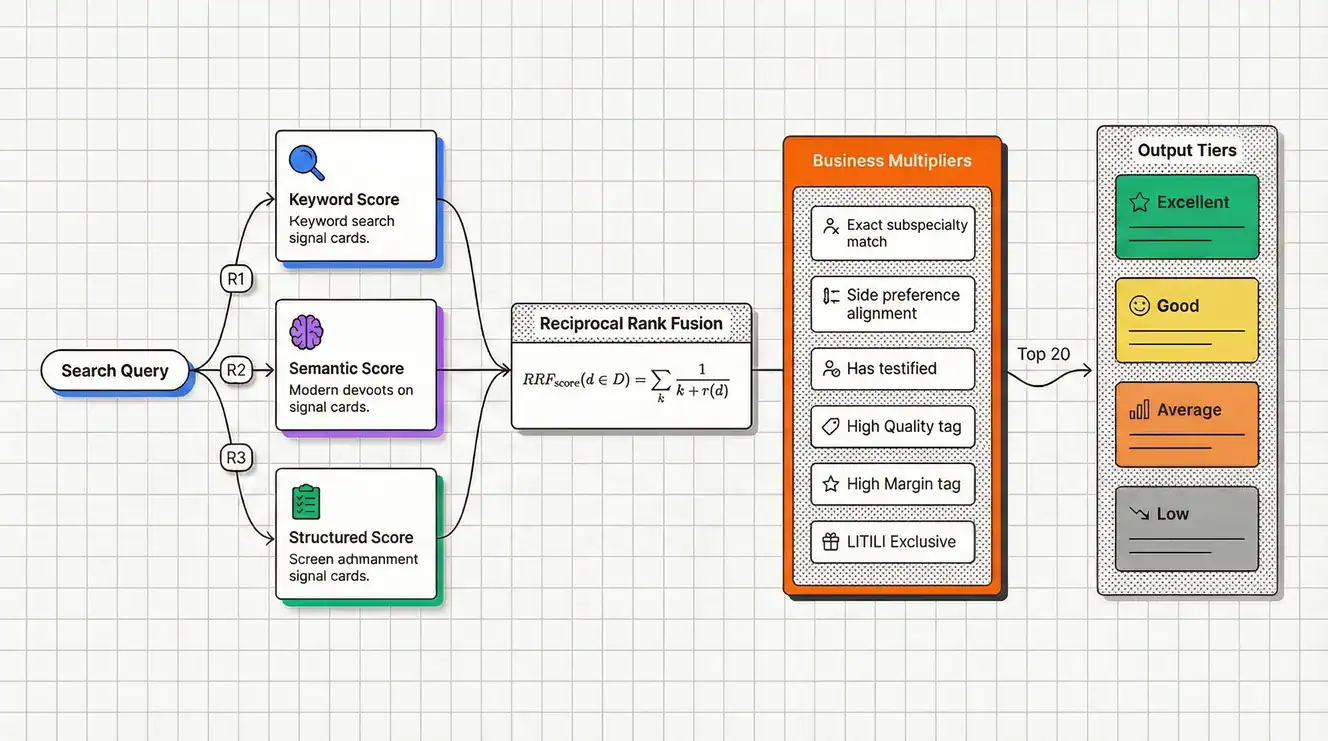
Scoring signals
The score is built from three independent signals, fused into one ranking:
1. Keyword score
Traditional text search. The system looks for your query terms in the expert's:
Subspecialty (highest weight)
Description (medium weight)
Notes (lower weight)
Exact matches score highest, but fuzzy/partial matches are also considered.
2. Semantic score
AI-powered meaning matching. Your query is converted to a vector embedding and compared against each expert's pre-computed bio embedding using cosine similarity. This catches matches that keyword search would miss; for example, a query for "heart surgeon" will match an expert whose profile says "cardiothoracic surgery."
3. Structured score
Direct field comparisons:
Does the expert's subspecialty exactly match what you searched for?
Does their side preference (plaintiff vs. defense ratio) align with the case?
Have they testified before? Do they have trial, deposition, or arbitration experience?
Reciprocal Rank Fusion
Rather than trying to weight the three scores directly, the system uses Reciprocal Rank Fusion (RRF), a proven technique that combines separate ranking lists into a single unified order. Each scoring method produces its own ranked list. RRF awards points based on rank position across all lists. The standard RRF formula is:

Where:
d: Expert candidate
n: Number of ranking lists (n=3: keyword, semantic, structured)
ri(d): Rank position of d in list i∈{1,…,n}
k: Smoothing constant (k=60)
In layman terms, RRF doesn't care about raw scores, only rank positions. An expert who ranks highly in multiple signals will surface to the top, even if no single signal gives them the highest raw score.
Business multipliers
After RRF, additional business rules adjust the final score:
Factor | Boost | When applied |
|---|---|---|
Exact subspecialty match | +25% | Query specialty found in expert's subspecialty |
Side preference alignment | +10% | Expert's plaintiff/defense ratio matches case |
Has testified | +5% | Expert has courtroom testimony experience |
High Quality tag | +15% | Salesforce tag indicates high quality |
High Margin tag | +10% | Salesforce tag indicates high margin |
LITILI Exclusive | +15% | Expert is exclusive to LITILI |
Boosts are multiplicative, not additive. An exclusive, high-quality expert with an exact subspecialty match could receive a combined boost of ~65%.
Reading the tiers
Tiers are guidelines, not decisions. An Excellent-scored expert may still have a conflict, and a Good-scored expert may be the perfect fit after reviewing their full profile. Tiers are score this way in the dashboard:
Tier | Score | Guidance |
|---|---|---|
🟢 Excellent | ≥ 0.85 | Strong match across multiple signals. Start your review here. |
🟡 Good | 0.70 – 0.84 | Solid candidate. May differ from your ideal on one dimension (e.g., distance or side preference). |
🔴 Fair | 0.50 – 0.69 | Partial match. Worth considering if Excellent/Good candidates are unavailable. |
⚪ Low | < 0.50 | Weak match. Usually means the expert only matched on one signal. |